
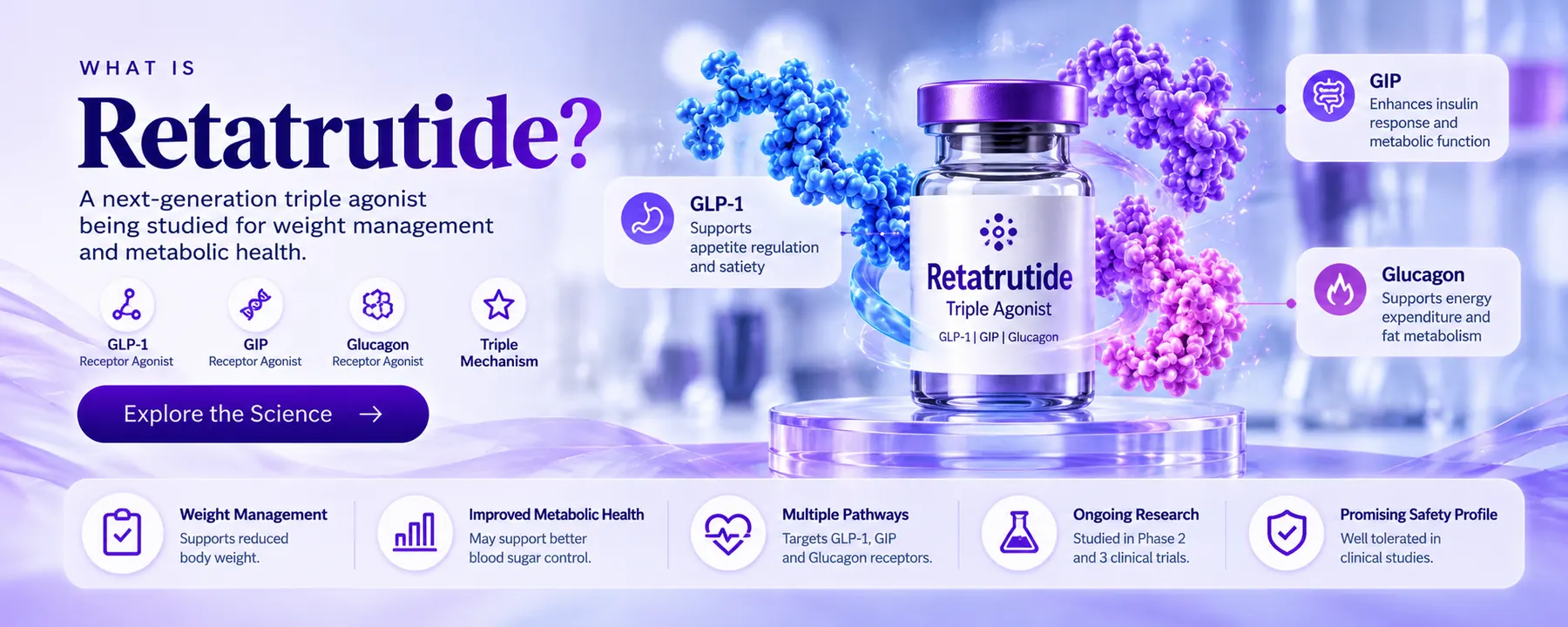
What Is Retatrutide? A Scientific Overview
Retatrutide is an investigational molecule, not an approved medicine. This page sets out what is established about it, what its trials have reported, and where the evidence stops.
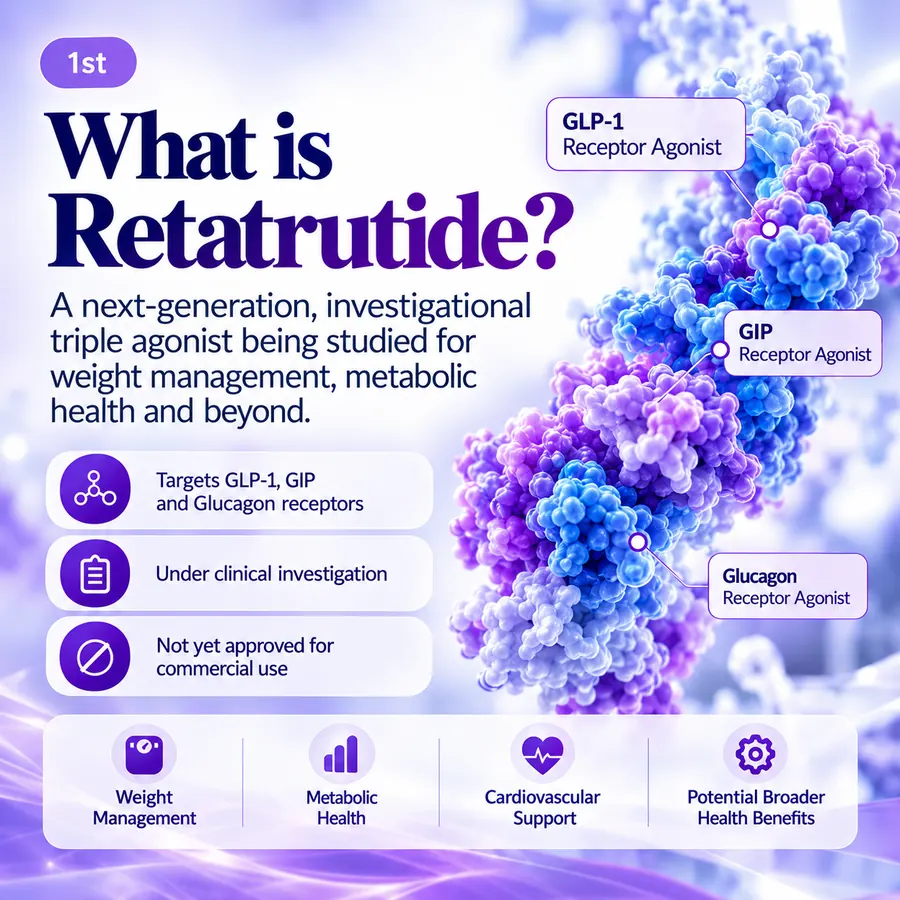
Retatrutide, development code LY3437943, is an investigational molecule developed by Eli Lilly and Company. Its developer describes it as a single molecule that activates three hormone receptors — GIP, GLP-1 and glucagon — which is why it is called a triple hormone receptor agonist. In clinical trials it is given as a once-weekly subcutaneous injection.
As of 24 October 2026 it has no marketing approval in any country. Four Phase 3 trials have reported results and one has been published in a peer-reviewed journal. Eli Lilly stated in July 2026 that it plans to file for United States approval in the first quarter of 2027.
The molecule's identity
Two names refer to the same substance. LY3437943 is the internal development code Eli Lilly used before a generic name was assigned; it is how the molecule appears in the earlier trial records. Retatrutide is the generic (non-proprietary) name. There is no brand name, because a brand name is assigned to an approved product and retatrutide is not one.
| Attribute | Value | Source |
|---|---|---|
| Generic name | Retatrutide | Eli Lilly announcements |
| Development code | LY3437943 | ClinicalTrials.gov NCT03841630 |
| Class | Triple hormone receptor agonist (GIP, GLP-1, glucagon) | Eli Lilly, 21 May 2026 |
| Route | Subcutaneous injection | Eli Lilly, 26 June 2023 |
| Frequency | Once weekly | All Phase 3 trial records |
| Originator | Eli Lilly and Company | ClinicalTrials.gov sponsor field |
| Regulatory status | Investigational. No marketing approval located in any jurisdiction. | See regulatory pages |
What we could not verify
We found no authoritative public source establishing retatrutide's molecular formula, molecular weight, amino-acid sequence, formulation, excipients, storage conditions or manufacturing specification. Pages elsewhere that state these figures do not cite a primary source we could locate. Rather than repeat them, we say plainly that they are not publicly established. See the ingredient profile →
What it is designed to do
Retatrutide belongs to the family of incretin-based molecules. Incretins are gut hormones released after eating that influence insulin release, appetite and digestion. Medicines in this family work by mimicking those hormones at their receptors.
What separates retatrutide from its predecessors is arithmetic: the number of receptors a single molecule engages.
| Molecule | GLP-1 receptor | GIP receptor | Glucagon receptor | Status |
|---|---|---|---|---|
| Semaglutide | Yes | — | — | Approved in many countries |
| Tirzepatide | Yes | Yes | — | Approved in many countries |
| Retatrutide | Yes | Yes | Yes | Investigational |
The glucagon receptor is the addition. Eli Lilly's chief scientific officer framed the rationale this way when the Phase 2 results were published:
We believe that combining glucagon receptor agonism with GIP and GLP-1 receptor agonism may be one of the reasons retatrutide showed this level of weight reduction. Daniel Skovronsky, Eli Lilly, 26 June 2023
Note the wording: we believe and may be. That is a hypothesis offered by the molecule's developer, not a demonstrated causal finding, and we present it as such. The mechanism page examines each pathway in detail →
What the research has shown so far
Retatrutide has moved through the standard phases of clinical research. The programme began with a first-in-human safety study in 2019 and now includes 33 registered studies.
- Phase 1 — thirteen studies, beginning with NCT03841630 in 45 healthy participants. These examined safety, tolerability and how the body handles the molecule.
- Phase 2 — a 48-week trial in 338 adults with obesity or overweight without diabetes (NCT04881760), published in the New England Journal of Medicine in June 2023. The primary endpoint was weight change at 24 weeks, where mean reduction reached 17.5%. At 48 weeks, a secondary endpoint, mean reduction reached 24.2%.
- Phase 3 — the TRIUMPH programme, which began in 2023 and enrolled more than 5,800 participants across its four initial registrational trials. All four have reported.
A detail worth keeping
The Phase 2 lead investigator noted that participants “had not yet reached a weight plateau at the time the study ended.” That observation is why the Phase 3 trials ran for 68 to 80 weeks rather than 48 — a good illustration of how one trial's limitation becomes the next trial's design question.
Across the four Phase 3 trials that have read out, mean weight reduction at the highest dose ranged from 20.8% in adults with type 2 diabetes to 28.7% in adults with knee osteoarthritis, under the efficacy estimand. Those populations differ substantially, and the numbers are not interchangeable. Full Phase 3 results, with estimands labelled →

What is not established
An honest overview has to be as clear about the gaps as the findings. As of 24 October 2026:
- No regulator has reviewed the complete data package. Eli Lilly said in July 2026 that it was still completing the manufacturing (CMC) documentation required for a United States filing, which it planned to submit in Q1 2027.
- Long-term outcomes are unknown. The longest reported exposure is 104 weeks, in a 532-participant extension. The dedicated cardiovascular and kidney outcomes trial, TRIUMPH-Outcomes, is not due to complete until February 2029.
- No published head-to-head comparison in obesity. TRIUMPH-5 compares retatrutide with tirzepatide directly, and had not reported as of 24 October 2026.
- Effects after stopping are not yet reported. TRIUMPH-6 is studying weight maintenance, with primary completion expected in 2028.
On availability
Eli Lilly has stated the position twice, in its own words:
Retatrutide is an investigational molecule that is legally available only to participants in Lilly's clinical trials. Eli Lilly, 21 May 2026
Retatrutide is an investigational molecule that cannot be legally sold or marketed for human use. Eli Lilly, 23 July 2026
There is consequently no approved product, no regulated supply chain and no legitimate retail price anywhere in the world. Material offered for sale online — including items labelled “research use only” — sits outside regulatory oversight, and its identity, purity and contents are unverified. This site does not supply, source or broker any product.
Where to go next
How it works
The three receptor pathways, what each is associated with, and the line between a proposed mechanism and a demonstrated outcome.
What the trials found
Every reported Phase 3 figure, with its population, duration and estimand attached.
Safety evidence
Reported adverse events across all four trials, and an account of what the safety data cannot yet establish.
Status in India and the UAE
What we could and could not verify in each jurisdiction, with the official sources to check for yourself.