
Retatrutide Ingredient Profile
What is publicly established about the molecule — and an explicit account of what is not.
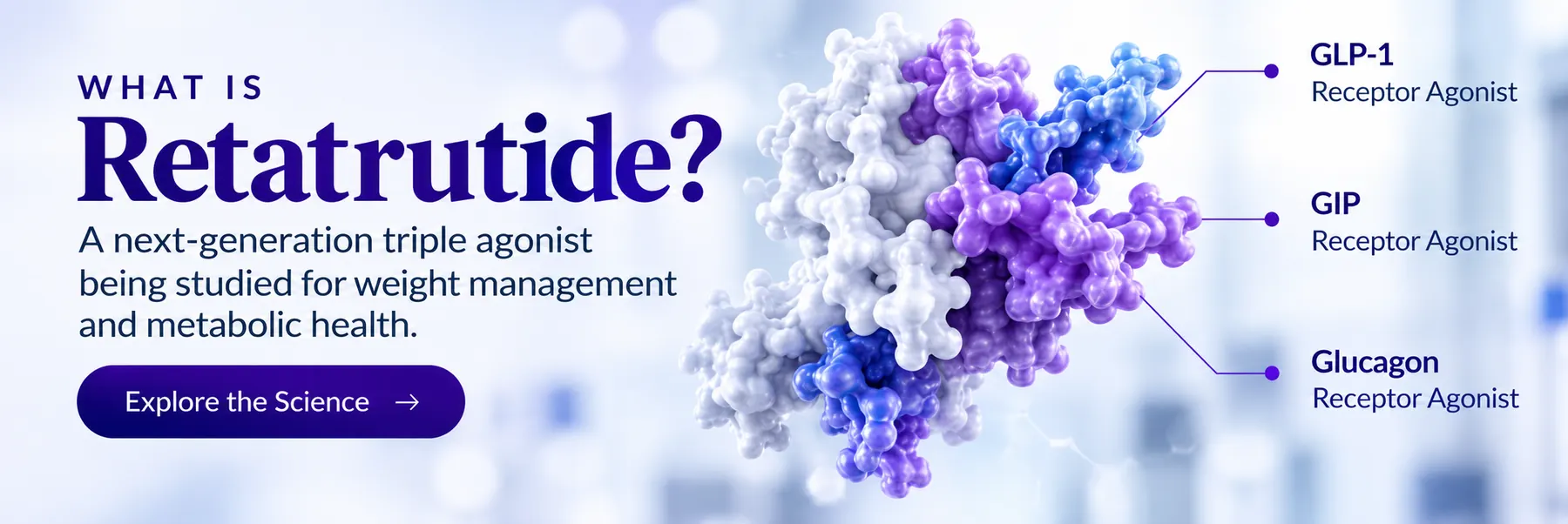
Retatrutide is identified publicly by its generic name, its development code LY3437943, its classification as a triple hormone receptor agonist acting at the GIP, GLP-1 and glucagon receptors, and its route and frequency in trials: subcutaneous, once weekly.
Beyond that, the public record is thinner than most pages on the internet suggest. We could not locate an authoritative public source establishing its molecular formula, molecular weight, amino-acid sequence, formulation, excipients, concentration or storage conditions. Rather than repeat unsourced figures, this page states what is verified and what is not.
Verified attributes
| Attribute | Value | Source |
|---|---|---|
| Generic name | Retatrutide | Eli Lilly announcements |
| Development code | LY3437943 | ClinicalTrials.gov NCT03841630 and all trial records |
| Brand name | None — no approved product exists | Follows from regulatory status |
| Pharmacological class | Triple hormone receptor agonist (GIP, GLP-1, glucagon) | Eli Lilly, 21 May 2026 and 23 July 2026 |
| Molecular target 1 | GIP receptor | Eli Lilly |
| Molecular target 2 | GLP-1 receptor | Eli Lilly |
| Molecular target 3 | Glucagon receptor | Eli Lilly |
| Route of administration | Subcutaneous injection | Eli Lilly, 26 June 2023 |
| Dosing frequency in trials | Once weekly | All Phase 3 trial records |
| Doses studied in Phase 3 | 4 mg, 9 mg, 12 mg (reached by stepwise escalation from 2 mg) | Eli Lilly trial design statements |
| Originator | Eli Lilly and Company | ClinicalTrials.gov sponsor field |
| First-in-human study | 2019 (NCT03841630, 45 healthy participants) | ClinicalTrials.gov |
| Regulatory status | Investigational; no marketing approval located in any jurisdiction | See regulatory pages |

What we could not verify
Not publicly established by any primary source we located
- Molecular formula
- Molecular weight
- Amino-acid sequence or structural characterisation
- Formulation, excipients or concentration
- Presentation (vial, pen or other device)
- Storage temperature, shelf life or stability data
- Manufacturing process or purity specification
- Any price, in any currency, in any country
Several of these appear on other websites. When we traced them, we could not find a primary public source behind them. They may be accurate; we simply cannot verify them, so we will not republish them as fact.
Why so little is public
This is normal for an investigational molecule rather than evidence of anything unusual. Detailed pharmaceutical specifications — formulation, manufacturing controls, stability — are submitted to regulators as part of the Chemistry, Manufacturing and Controls package, which is commercially confidential. Much of it becomes public only when a regulator approves a product and publishes its assessment and labelling.
Eli Lilly stated on 23 July 2026 that it was still completing the CMC data package required for a United States filing, which it planned to submit in Q1 2027. Until a regulator reviews and publishes, the detailed specification stays unpublished.
On “research grade” and certificates of analysis
Why unpublished specifications matter commercially
Products sold online as retatrutide often carry a stated purity, a concentration, and a certificate of analysis. The gap in the public record is precisely what makes those claims impossible for a buyer to check.
- There is no published reference specification to compare a certificate against.
- A certificate supplied by the seller is not independent verification.
- “Research use only” labelling is a legal disclaimer, not a quality assurance.
- No regulator has assessed the identity, purity, concentration or sterility of any such material.
Eli Lilly states the molecule “cannot be legally sold or marketed for human use”. This site does not supply, source, broker or recommend any product, and publishes no handling, storage, preparation or administration instructions.