

Retatrutide Safety: What the Evidence Shows
What the four reported Phase 3 trials found — and an equally careful account of what the safety data cannot yet establish.
Across four Phase 3 trials, the adverse events reported were, in Eli Lilly's words, “generally consistent with trials of other incretin-based therapies” — predominantly gastrointestinal. One signal stands somewhat apart from the class: dysesthesia, an altered or unpleasant sensation, which was clearly dose-related and reached 20.9% at the highest dose in one trial.
None of this establishes that retatrutide is safe. Trial safety data describe what happened to screened, supervised participants over a defined period. The longest reported exposure is 104 weeks, no regulator has reviewed the complete package, and the dedicated long-term outcomes trial does not complete until February 2029.
Most commonly reported adverse events
Figures below are as reported by Eli Lilly for each trial. Populations differ, so columns within a trial are comparable while rows across trials are not.
| Event | 4 mg | 9 mg | 12 mg | Placebo |
|---|---|---|---|---|
| Nausea | 28.6 | 38.4 | 42.4 | 14.8 |
| Diarrhoea | 25.2 | 34.1 | 32.0 | 13.5 |
| Constipation | 23.8 | 25.9 | 26.1 | 10.9 |
| Vomiting | 10.6 | 22.8 | 25.3 | 4.8 |
| Upper respiratory infection | 14.2 | 12.2 | 13.1 | 11.6 |
| Dysesthesia | 5.1 | 12.3 | 12.5 | 0.9 |
| Urinary tract infection | 7.5 | 8.8 | 8.4 | 5.3 |
The upper respiratory infection row is a useful calibration: rates were close to placebo (14.2/12.2/13.1 versus 11.6), which is what a finding with no clear treatment relationship tends to look like. Contrast that with vomiting, where the gradient from placebo to 12 mg is steep.
| Event | T2: 4 mg | T2: 9 mg | T2: 12 mg | T2: PBO | T3: 9 mg | T3: 12 mg | T3: PBO |
|---|---|---|---|---|---|---|---|
| Diarrhoea | 27.4 | 33.5 | 33.6 | 13.2 | 30.1 | 24.4 | 8.7 |
| Nausea | 13.7 | 20.8 | 28.0 | 8.0 | 21.7 | 22.4 | 5.8 |
| Constipation | 14.0 | 16.2 | 16.8 | 9.4 | 18.0 | 15.7 | 7.1 |
| Decreased appetite | 5.8 | 12.3 | 17.1 | 4.5 | 13.5 | 14.5 | 3.0 |
| Dysesthesia | 4.5 | 5.6 | 7.3 | 0.7 | 6.4 | 6.4 | 1.3 |
| Hyperglycaemia | — | — | — | — | 3.9 | 3.1 | 13.4 |
T2 = TRIUMPH-2; T3 = TRIUMPH-3; PBO = placebo. Hyperglycaemia was reported for TRIUMPH-3 only.
The hyperglycaemia row runs the other way: it was reported more often on placebo (13.4%) than on retatrutide (3.9% and 3.1%). Not every adverse event favours the control arm.
The dysesthesia signal
Dysesthesia means an altered or unpleasant sensation — burning, tingling, or discomfort from ordinary touch. It appeared in every reported retatrutide trial, rose with dose, and was consistently far above placebo.
| Trial | 4 mg | 9 mg | 12 mg | Placebo |
|---|---|---|---|---|
| TRIUMPH-1 | 5.1 | 12.3 | 12.5 | 0.9 |
| TRIUMPH-2 | 4.5 | 5.6 | 7.3 | 0.7 |
| TRIUMPH-3 | — | 6.4 | 6.4 | 1.3 |
| TRIUMPH-4 | — | 8.8 | 20.9 | 0.7 |
Eli Lilly described these events as generally mild to moderate, stated that the majority resolved during treatment, that most participants continued treatment, and in TRIUMPH-4 that they “rarely led to treatment discontinuation”.
Why we draw attention to it
Not because it is alarming — the reported severity was mild to moderate and most events resolved. We highlight it because it is not a typical effect of the GLP-1 class, it is clearly dose-related, and the range across trials is wide (6.4% to 20.9% at comparable doses). A finding that varies this much between populations is one where more data would be genuinely informative. We have not found a published mechanistic explanation.

Discontinuation due to adverse events
How many people stopped because of side effects is often more informative than how many experienced them, because it reflects whether events were tolerable in practice.
| Trial | 4 mg | 9 mg | 12 mg | Placebo |
|---|---|---|---|---|
| TRIUMPH-1 | 4.1 | 6.9 | 11.3 | 4.9 |
| TRIUMPH-2 | 3.8 | 11.6 | 7.7 | 4.9 |
| TRIUMPH-3 | — | 9.8 | 13.5 | 4.8 |
| TRIUMPH-4 | — | 12.2 | 18.2 | 4.0 |
Three observations worth making, none of them tidy:
- The 4 mg dose was tolerated about as well as placebo. In TRIUMPH-1, 4.1% discontinued on 4 mg against 4.9% on placebo — slightly lower than the control arm, while still producing a reported 19.0% weight reduction.
- TRIUMPH-2 is not dose-ordered. 11.6% discontinued on 9 mg against 7.7% on 12 mg. We report it as stated rather than smoothing it into a trend.
- TRIUMPH-4's 18.2% has a stated explanation. Eli Lilly said these rates “were highly correlated with baseline BMI and included discontinuations for perceived excessive weight loss”. Restricted to participants with baseline BMI ≥35, the rates fell to 8.8% and 12.1% against 4.8% on placebo.
What the cardiovascular data do and do not show
Neither benefit nor harm is established
TRIUMPH-3 reported cardiovascular event analyses: MACE-5 hazard ratio 0.82 (95% CI 0.55–1.22) and MACE-3 hazard ratio 1.12 (95% CI 0.64–1.96), in-study, pre-specified.
Both intervals cross 1.0. Event counts were small (44 vs 52; 27 vs 23), and the trial was powered for weight change, not cardiovascular outcomes. The 0.82 figure is not evidence of cardiovascular protection; the 1.12 figure is not evidence of cardiovascular risk. The trial designed to answer this is TRIUMPH-Outcomes (NCT06383390), about 10,000 participants, primary completion February 2029. Full analysis →
The limits of this evidence
Everything above describes what was observed in clinical trials. Five limits bound how far it can be carried.
- Duration. The longest reported exposure is 104 weeks, and that was in a selected extension subgroup of 532 people who had already tolerated 80 weeks. Obesity is managed over decades; two years of data is a start.
- Selected populations. Participants met eligibility criteria that excluded many people — other conditions, other medicines, pregnancy. A trial population is not the general population.
- Supervision. Participants were screened, monitored, and had dose adjustments managed by investigators under a protocol. Safety observed under supervision does not transfer to unsupervised use.
- Association is not causation. An adverse event recorded during a trial is an event that happened, not necessarily one the molecule caused. The placebo column is what lets you judge — and why we always show it.
- Most of this is not yet peer-reviewed. TRIUMPH-1 has been published. The TRIUMPH-2, TRIUMPH-3 and TRIUMPH-4 figures come from sponsor announcements, which are not subject to independent review before release.
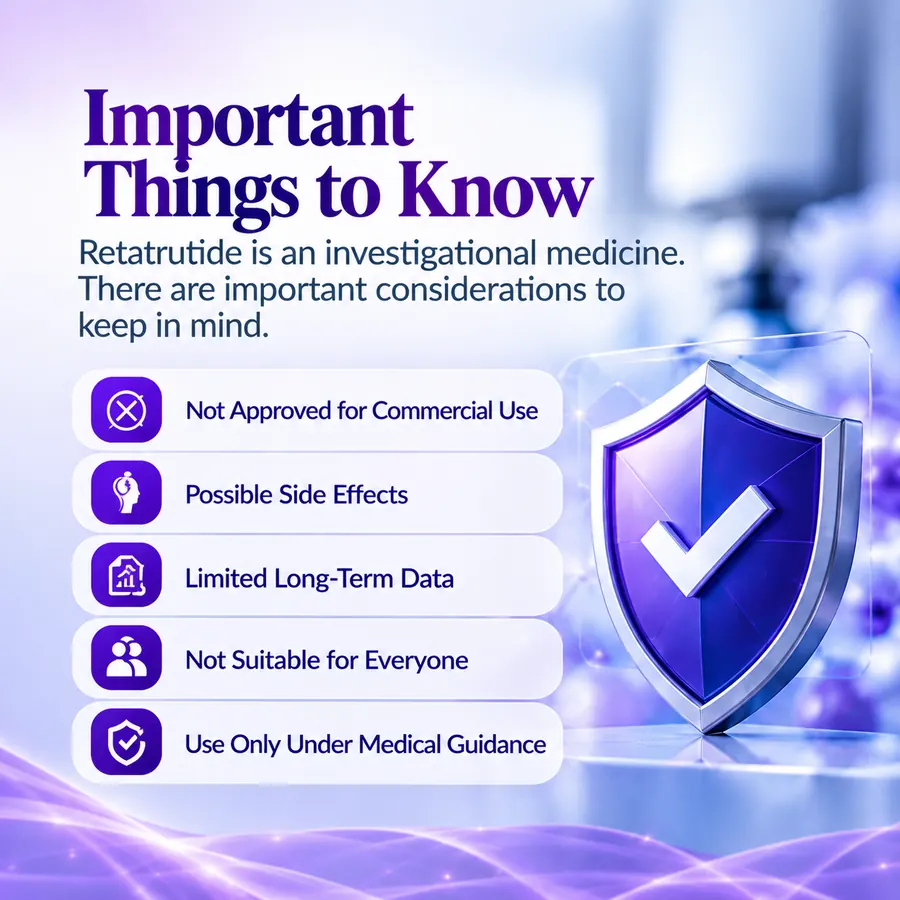
A separate risk: unverified product
This risk is not about the molecule
Everything above concerns retatrutide as administered in trials: a known substance, at a known dose, manufactured to pharmaceutical standards, given under supervision. Material bought online shares none of those properties.
- No regulator has assessed its identity, purity, concentration or sterility.
- A vendor-supplied certificate of analysis is not independent verification.
- “Research use only” labelling is not a safety assurance; it is a disclaimer.
- There is no pharmacovigilance system, so harms are not systematically recorded.
The trial safety data on this page describe a product that is not what is being sold online. They should not be read as reassurance about anything bought from an unregulated source.