

How Retatrutide Is Studied
Clinical trial protocols, safety monitoring and evidence — an educational guide to how an investigational medicine is actually researched.
Read this before anything else on this page
This page explains how clinical research is designed and conducted. Where it describes doses used in retatrutide trials, that is a description of research design under medical supervision — not guidance for any individual. This site publishes no dosing recommendations, no dose calculators, no reconstitution or injection instructions, and no route to obtaining investigational material. Those regimens exist inside ethics-approved protocols with screening, monitoring and clinical oversight that cannot be reproduced outside a trial.
Retatrutide is studied through registered clinical trials that follow a written protocol fixed in advance. The protocol states who may take part, what they receive, what will be measured and how it will be analysed. Participants are randomised to retatrutide or a comparator, usually with both participant and investigator blinded. Outcomes are declared before results are known, and safety is monitored continuously by investigators and independent committees.
What a protocol is, and why it matters
A protocol is the complete written plan for a trial, finalised before the first participant enrols. It specifies the question, who is eligible, what participants receive, what is measured and when, how results will be analysed, and what triggers stopping.
The reason this is powerful is simple. Because the plan is registered in advance, researchers cannot look at the data, notice something interesting, and present it as though it were the question all along. If the protocol says the primary endpoint is percent weight change at 80 weeks, that is the result the trial stands or falls on — whatever else turns up.
Pre-specified, post-hoc, and why the labels appear on our pages
Pre-specified analyses are declared in the protocol before results are seen. Post-hoc analyses are performed afterwards. Post-hoc findings are not worthless — they generate hypotheses — but they carry much less weight, because with enough looks at a dataset something interesting always appears. We label post-hoc results wherever we report them, as Eli Lilly does in its own releases.
Why dose escalation exists in trial design
In every retatrutide Phase 3 trial, participants began at 2 mg once weekly and increased stepwise every four weeks until reaching their assigned target dose. For the 12 mg group that meant steps at 2, 4, 6 and 9 mg before reaching 12.
Escalation serves three research purposes:
- Tolerability. Gastrointestinal effects in this class tend to be worst during escalation. Stepping up gradually allows adaptation.
- Observation. Investigators observe how each participant responds at each step before increasing further.
- Comparison. Studying several target doses lets a trial examine where benefit and tolerability balance. TRIUMPH-1's 4 mg arm is a good example: it produced a reported 19.0% weight reduction with a discontinuation rate below placebo.
Why this is not a dosing guide
In a trial, every step is accompanied by eligibility screening, scheduled clinical assessment, laboratory monitoring, pre-defined rules for pausing or reducing dose, and investigators who can intervene. The schedule is not the treatment — the supervision around it is an inseparable part of the design. A number copied out of a protocol, without any of that, is not the same intervention.

Randomisation, blinding and comparators
Randomisation assigns participants to groups by chance. Its purpose is to make the groups comparable at the outset, including on factors nobody thought to measure. TRIUMPH-1 randomised 1:1:1:1 across three doses and placebo; TRIUMPH-3 used 1:1:2, placing twice as many participants in the placebo arm.
Blinding means not knowing which group someone is in. The retatrutide Phase 3 trials were double-blind: both participant and investigator were masked. This matters most for subjective measures — in TRIUMPH-4, the placebo group reported a 2.4-point improvement in knee pain, which is exactly the sort of effect blinding and a control arm exist to separate from treatment.
A comparator is what the treatment is measured against. Most retatrutide Phase 3 trials used placebo. A few use an active comparator — TRIUMPH-5 against tirzepatide, NCT06260722 against semaglutide — which answers a different and often more useful question: not “does it work?” but “does it work better than what we have?”
Endpoints and estimands
An endpoint is what the trial measures. The primary endpoint is the one it is designed and powered to answer; secondary endpoints are additional pre-specified measures. In TRIUMPH-1 the primary endpoint was percent change in body weight at 80 weeks.
An estimand is the precise definition of what a number represents — specifically, how it handles people who stopped treatment. This is the single most useful concept for reading this class of evidence, and the reason the same trial is correctly reported as both 28.3% and 25.0%. The full explanation, with the figures →
How safety is monitored
- Systematic recording. Every adverse event is recorded whether or not it appears related to treatment. That is why trial tables list events like upper respiratory infection that occur at similar rates on placebo.
- Scheduled assessment. Clinical review and laboratory tests at fixed intervals, not only when someone reports a problem.
- Pre-defined rules. The protocol states in advance what triggers pausing, reducing or stopping treatment.
- Independent oversight. Ethics committees approve the protocol; independent monitoring committees can review accumulating data, including unblinded data, and recommend changes or stopping.
Eligibility criteria — and why they limit conclusions
Every trial defines inclusion criteria (who may join) and exclusion criteria (who may not). TRIUMPH-4, for instance, required a BMI of 27.0 or above and American College of Rheumatology criteria for knee osteoarthritis, and excluded people with diabetes.
These criteria produce clean science and a real limitation at once. A result established in a selected population does not automatically transfer to people who would have been excluded. This is why “the trial showed X” and “X will happen to me” are different statements.

How to read an official trial record
Anyone can inspect the primary record. Here is what to look at, in order.
| Field | What it tells you |
|---|---|
| NCT number | The unique identifier. If a claim about a trial has no identifier, you cannot check it. |
| Sponsor | Who is running and funding it. |
| Phase | What stage of research, and therefore what kind of question it can answer. |
| Status | Recruiting, active, completed or terminated. “Completed” means finished, not successful. |
| Enrolment | How many participants, and whether the figure is actual or estimated. |
| Study design | Randomised? Masked, and from whom? Against what comparator? |
| Outcome measures | Pre-declared endpoints with their time frames. The core of the record. |
| Eligibility | Who could take part — which bounds who the results apply to. |
| Locations | Participating countries and sites. |
| Last update | How current the record is. |
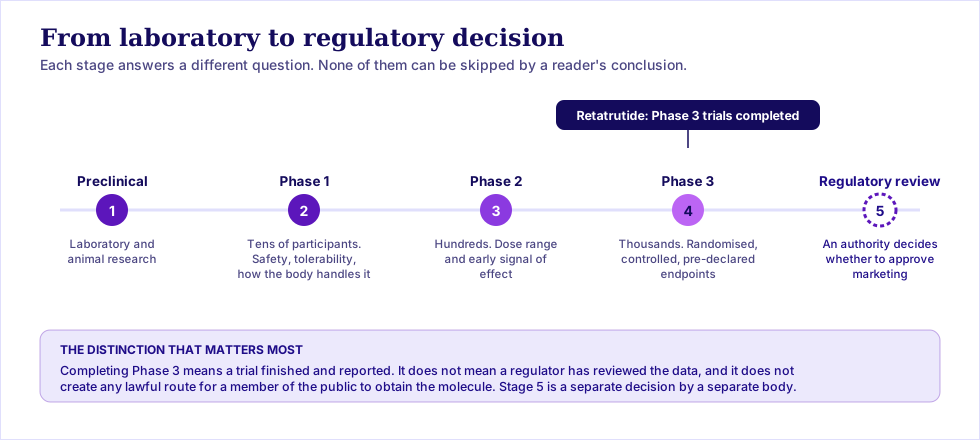
A completed trial is not an approval
“Completed” on a registry record means the trial finished. It says nothing about whether results were positive, whether a regulator has reviewed them, or whether the molecule may lawfully be sold. Retatrutide has four completed Phase 3 trials and no marketing approval anywhere.