
Retatrutide vs Tirzepatide
One difference is real, documented and structural. The other — the one everybody wants — has not been measured yet.
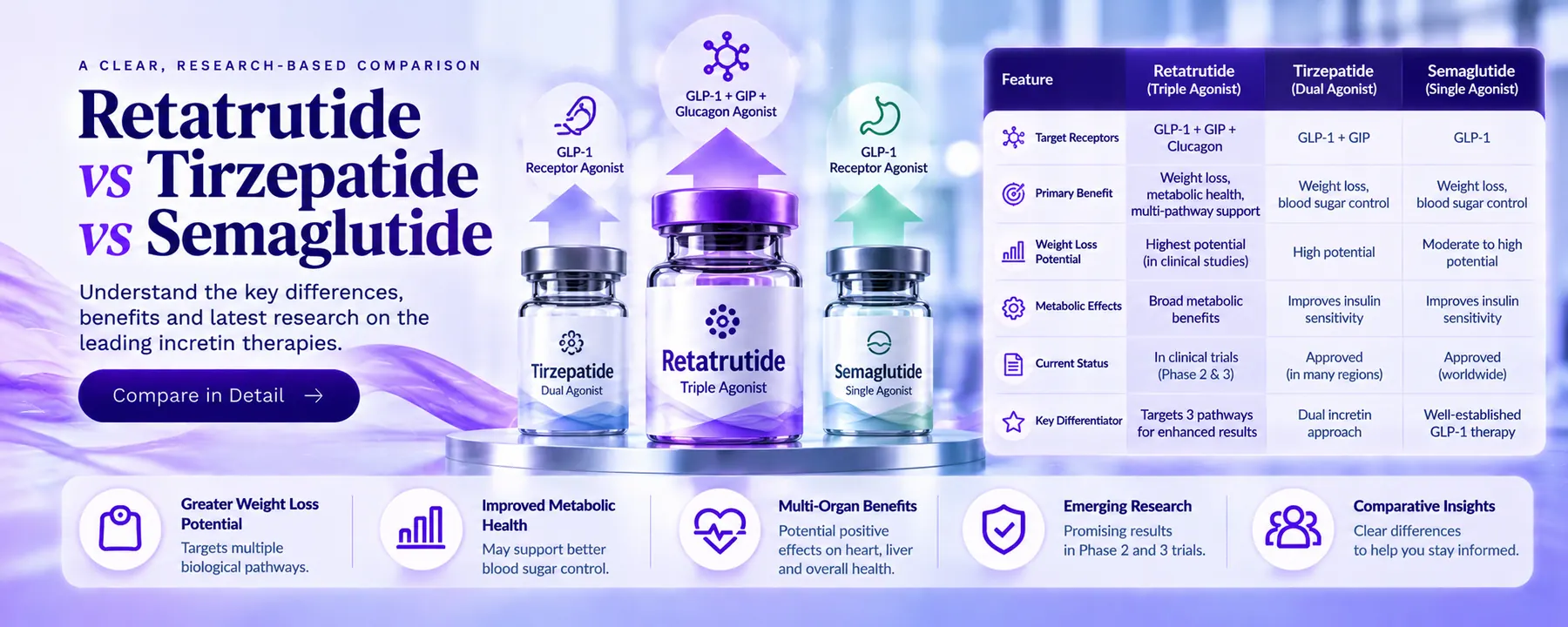
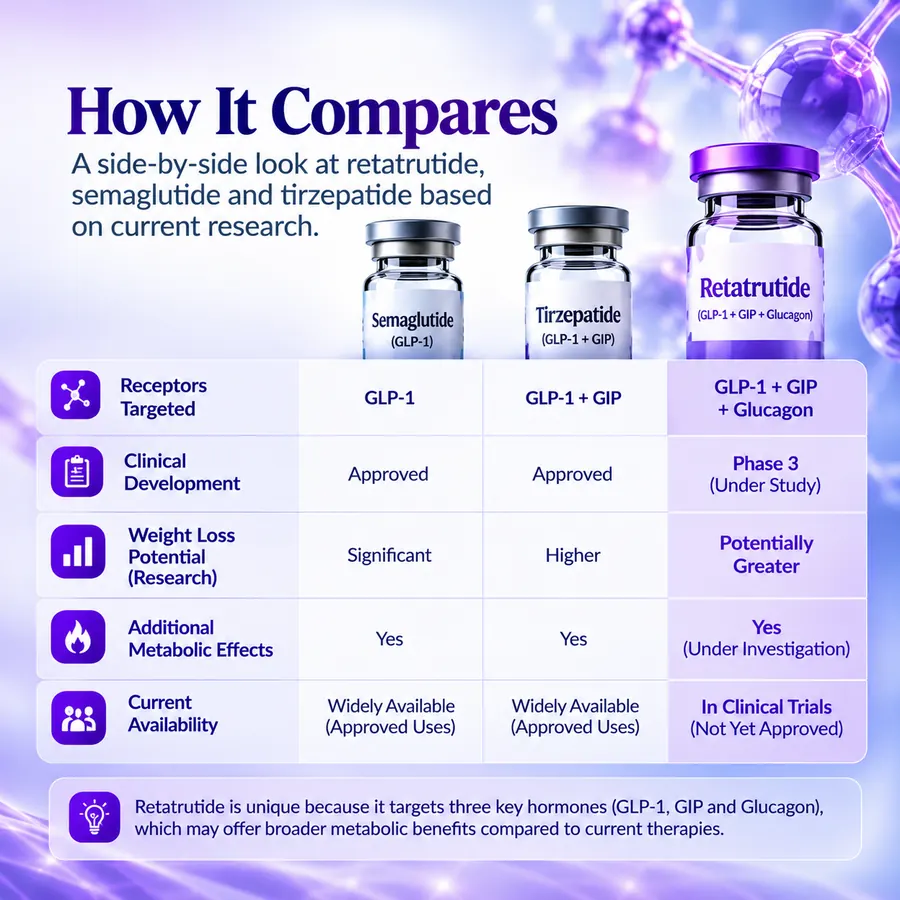
Mechanistically: tirzepatide is a dual agonist, acting at the GIP and GLP-1 receptors. Retatrutide is a triple agonist, adding the glucagon receptor. That difference is established and documented.
Regulatorily: tirzepatide is an approved medicine in many countries. Retatrutide is investigational and approved nowhere.
On effectiveness: no published head-to-head trial in obesity exists. TRIUMPH-5 (NCT06662383) is comparing them directly in about 800 adults over 80 weeks, and had not reported as of 24 October 2026. Until it does, anyone telling you which is more effective is comparing numbers from different trials, which is not a reliable method.
The mechanistic difference
| Tirzepatide | Retatrutide | |
|---|---|---|
| GLP-1 receptor | Yes | Yes |
| GIP receptor | Yes | Yes |
| Glucagon receptor | — | Yes |
| Class | Dual agonist | Triple agonist |
| Route & frequency | Subcutaneous, once weekly | Subcutaneous, once weekly (in trials) |
| Developer | Eli Lilly | Eli Lilly |
| Regulatory status | Approved in many countries | Investigational |
Both molecules come from the same company, which is unusual and worth noting: Eli Lilly is running a trial of its own investigational molecule against its own approved one.
The glucagon receptor is associated with hepatic glucose output and energy expenditure. The stated rationale for adding it is that where GLP-1 and GIP agonism act largely on energy intake, glucagon agonism engages energy expenditure. More on the three pathways →
More receptors does not automatically mean better
Additional pathways can produce additional effects, wanted and unwanted. Retatrutide trials reported dysesthesia at rates well above placebo, rising with dose and reaching 20.9% at 12 mg in TRIUMPH-4 — a signal that is not characteristic of the GLP-1 class. Whether the triple mechanism delivers a better overall balance is exactly what a head-to-head trial is for.
The head-to-head trial
| Field | Detail |
|---|---|
| Registry ID | NCT06662383 |
| Design | Phase 3, randomised, double-blind |
| Comparison | Retatrutide vs tirzepatide |
| Population | Adults with obesity |
| Enrolment | 800 |
| Primary endpoint | Percent change in body weight at week 80 |
| Status | Active, not recruiting |
| Primary completion | November 2026 (recorded) |
| Results | Not reported as of 24 October 2026 |
Why cross-trial comparison fails here
The temptation is obvious: take retatrutide's reported 28.3% from TRIUMPH-1, take a tirzepatide figure from one of its own trials, and subtract. Here is why that produces a number that means very little.
- Different populations. Eligibility criteria, baseline weight, diabetes status and comorbidities differ between trial programmes.
- Different durations. A result at 72 weeks and a result at 80 weeks are not the same measurement.
- Different estimands. If one figure uses an efficacy estimand and the other a treatment-regimen estimand, the comparison is broken before it starts. For TRIUMPH-1 alone, that choice moves the number from 28.3% to 25.0%.
- Different eras and background care. Trials run years apart differ in standard of care, monitoring and participant expectations.
- No randomisation between them. The whole point of randomisation is to make groups comparable. Two separate trials were never randomised against each other, so none of that protection applies.
What we will not publish
We will not put a retatrutide percentage and a tirzepatide percentage side by side in a table and let the layout imply a comparison the evidence does not support. When TRIUMPH-5 reports, we will publish its findings here with the population, duration and estimand attached.
What is already settled
One part of this comparison is not uncertain at all. Tirzepatide is an approved medicine that can be lawfully prescribed and dispensed in many countries, with approved labelling, known manufacturing standards and an active pharmacovigilance system behind it.
Retatrutide has none of those things. Its developer states it “cannot be legally sold or marketed for human use”. Whatever TRIUMPH-5 eventually shows, that difference stands today.