
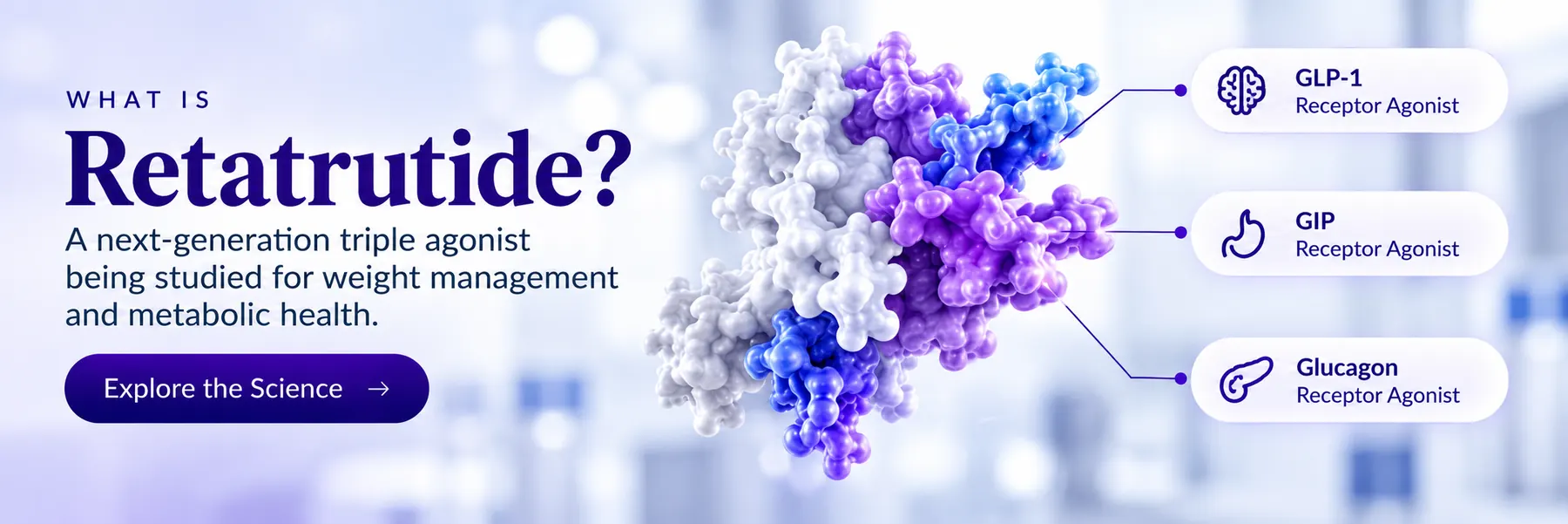
Retatrutide Research: Ingredient Information, Clinical Evidence and Latest Studies
Explore evidence-based information about retatrutide, an investigational triple hormone receptor agonist. Learn about its mechanism of action, clinical-trial research, published findings, safety evidence and regulatory developments in India and the United Arab Emirates.
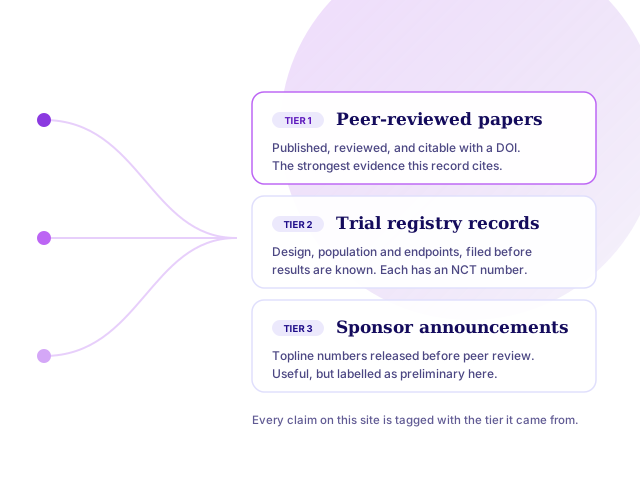
Every figure on this site is traced to a primary source — a peer-reviewed paper, a trial registry record, or the developer's own announcement — and labelled with which one.
The molecule and how it is thought to work
What is publicly established about retatrutide — and, just as importantly, what is not.
Ingredient & molecule profile
Its names, its classification, its route of administration, and an honest account of the properties — structure, formulation, storage — that are not publicly established by any primary source.
View the profile →Mechanism of action
What the GIP, GLP-1 and glucagon pathways do, why targeting all three at once is the scientific rationale under investigation, and where a proposed mechanism ends and a demonstrated outcome begins.
Understand the mechanism →How it is studied
How investigators design a trial protocol, why doses are escalated under ethics-approved supervision, what endpoints and estimands mean, and how to read an official trial record for yourself.
See the research methods →The triple receptor mechanism
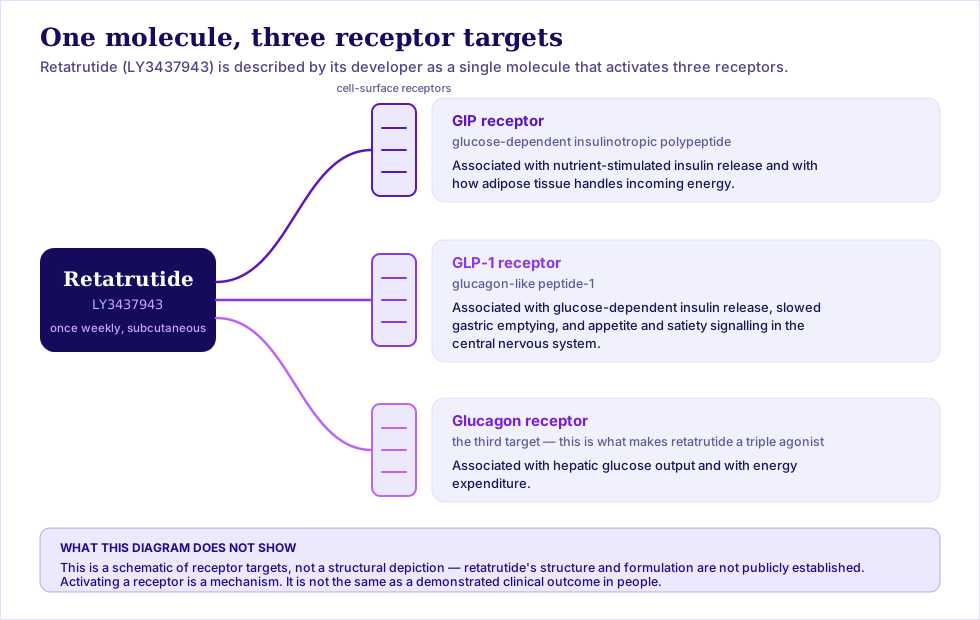
Retatrutide's defining feature is that one molecule engages three receptors. Semaglutide targets one of them; tirzepatide targets two. The third target — the glucagon receptor — is what makes retatrutide a triple agonist.
Latest verified research updates
Each entry records what the source actually reported, and whether it was peer-reviewed or a sponsor announcement.
-
TRIUMPH-1 published in the New England Journal of Medicine
Peer-reviewed The main Phase 3 obesity trial appeared in full, under the title “Retatrutide, a Triple Hormone Receptor Agonist, for Treatment of Obesity” (DOI 10.1056/NEJMoa2604169). The abstract reports a 25.0% mean weight reduction at the 12 mg dose versus 3.9% for placebo — the treatment-regimen estimand, which is why it differs from the 28.3% figure in the May press release.
-
TRIUMPH-2 and TRIUMPH-3 topline results; US filing planned for Q1 2027
Sponsor announcement In adults with type 2 diabetes, weight reduction reached 20.8% at 80 weeks with A1C reductions up to 1.6%. In adults with severe obesity and established cardiovascular disease, weight reduction reached 22.6%. Eli Lilly said it plans to submit a Biologics License Application to the US FDA in Q1 2027.
-
TRIUMPH-1 topline results
Sponsor announcement All three doses met the primary and key secondary endpoints. The 12 mg group lost a mean of 28.3% of body weight at 80 weeks under the efficacy estimand. In a pre-specified extension of 532 participants with BMI of 35 or above, mean reduction reached 30.3% at 104 weeks.
-
TRIUMPH-4 — the programme's first Phase 3 readout
Sponsor announcement In 445 adults with obesity and knee osteoarthritis, the 12 mg dose produced a mean 28.7% weight reduction at 68 weeks, alongside a 4.4-point reduction in the WOMAC pain subscale. This trial also reported the programme's highest rate of dysesthesia (20.9% at 12 mg).
Clinical trial evidence at a glance
Thirty-three retatrutide studies are listed on ClinicalTrials.gov. Four Phase 3 trials have reported headline results. Below are the primary weight endpoints as each source stated them.
| Trial | Population | Randomised | Duration | Highest dose result | Placebo |
|---|---|---|---|---|---|
| TRIUMPH-1 | Obesity/overweight, no diabetes | 2,339 | 80 wk | −28.3% (12 mg) | −2.2% |
| TRIUMPH-2 | Obesity/overweight with type 2 diabetes | 1,152 | 80 wk | −20.8% (12 mg) | −4.0% |
| TRIUMPH-3 | Severe obesity with established CVD | 1,949 | 80 wk | −22.6% (12 mg) | −3.2% |
| TRIUMPH-4 | Obesity/overweight with knee osteoarthritis | 445 | 68 wk | −28.7% (12 mg) | −2.1% |
Read these numbers carefully
Each trial enrolled a different population with a different baseline weight, so the percentages are not comparable across rows. All four figures use the efficacy estimand, which estimates the effect had participants remained on treatment. The same trials report lower numbers under the treatment-regimen estimand, which counts everyone regardless of whether they stayed on treatment. We explain the difference in detail, because it is the single most common source of confusion about this molecule.
Safety evidence and its limits
Reported adverse events are only part of the picture. What the evidence cannot yet establish matters just as much.
What the trials reported
Gastrointestinal events were the most common across all four Phase 3 trials. In TRIUMPH-1, nausea occurred in 42.4% of the 12 mg group against 14.8% on placebo, with diarrhoea, constipation and vomiting also more frequent than placebo.
A less familiar signal is dysesthesia — altered or unpleasant sensation — reported in 12.5% of the TRIUMPH-1 12 mg group versus 0.9% on placebo, and in 20.9% of the TRIUMPH-4 12 mg group versus 0.7%.
Discontinuation due to adverse events rose with dose in most trials, reaching 18.2% at 12 mg in TRIUMPH-4 against 4.0% on placebo.
What remains unknown
- Long-term safety. The longest reported exposure is 104 weeks, in a 532-participant extension. The dedicated cardiovascular and kidney outcomes trial, TRIUMPH-Outcomes, is not due to complete until February 2029.
- Cardiovascular effect. TRIUMPH-3 reported cardiovascular event data, but every confidence interval crossed 1.0 and the event counts were small. Those data establish neither benefit nor harm.
- Generalisability. Trial participants met strict eligibility criteria and were monitored throughout. Results from a selected, supervised population do not automatically transfer to any individual.
Regulatory status in India and the UAE
The two markets are not in the same position, and we do not assume that a finding in one applies to the other.
India
- Trial sites verified
- No approval record found
India does host authorised retatrutide clinical trial sites. We verified participating sites in five studies — including TRIUMPH-1, TRIUMPH-2 and TRIUMPH-Outcomes — across cities from Ahmedabad and Mumbai to Chennai, Kolkata and New Delhi.
No CDSCO record of marketing approval could be located. A trial authorisation and a marketing approval are different decisions, and only the second permits sale.
India regulatory status →United Arab Emirates
- No approval record found
- No UAE trial sites listed
No registration of retatrutide as a medicine with MoHAP or the Emirates Drug Establishment could be located in a primary record.
Separately, we checked the location data of all 33 retatrutide studies on ClinicalTrials.gov and found no study site in the UAE. The only West Asian locations anywhere in the programme are in Israel and Türkiye.
UAE regulatory status →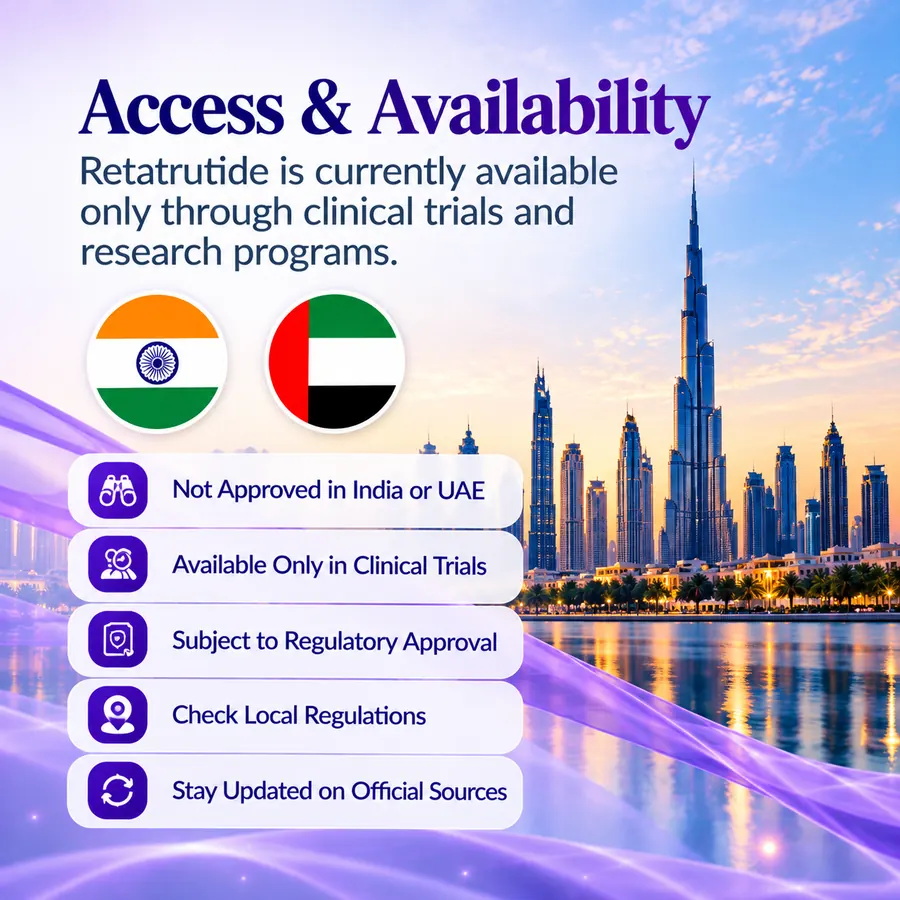
On products offered for sale online
Because retatrutide has no marketing approval anywhere, there is no regulated supply chain and no legitimate retail price. Material advertised online as retatrutide — including items labelled “research use only” — sits outside regulatory oversight, and its identity, purity and contents are unverified. This site does not supply, source, broker or recommend any product, and publishes no dosing or administration guidance.
Featured research articles
Longer explainers on the questions readers ask most.
Why one trial reports two different results
TRIUMPH-1 reported both 28.3% and 25.0% for the same dose. Neither is wrong. Understanding estimands explains why — and inoculates you against a lot of bad reporting.
Read the article →How to verify a clinical trial for yourself
A step-by-step method for checking whether a trial is real, what it actually measured, and whether its results have been reported — using free public registries.
Read the article →What “investigational medicine” actually means
The term appears in every retatrutide announcement. It carries a precise regulatory meaning that determines what may lawfully happen to the molecule — and what may not.
Read the article →Frequently asked questions
Short, sourced answers to the questions readers in India and the UAE search for most.
Is retatrutide approved in India?
No marketing approval for retatrutide in India could be located in any primary regulatory record as of 24 October 2026. India does host authorised clinical trial sites, which is a different regulatory act: a trial authorisation permits research under an approved protocol and does not permit general sale.
Is retatrutide approved or available in the UAE?
No registration of retatrutide as a medicine in the UAE could be located in a primary regulatory record, and no UAE clinical trial site appears in any of the 33 retatrutide studies on ClinicalTrials.gov, as of 24 October 2026.
We state this as what our search found, not as a legal determination. Verify current status directly with MoHAP and the Emirates Drug Establishment. Full UAE page →
Can I buy retatrutide legally?
No. Eli Lilly stated on 23 July 2026 that retatrutide “is an investigational molecule that cannot be legally sold or marketed for human use”, and on 21 May 2026 that it “is legally available only to participants in Lilly's clinical trials”.
There is therefore no legitimate retail supply and no genuine retail price. This site does not sell, source or broker any product, and cannot help anyone obtain the molecule.
What dose is used, and what dose should I take?
Trials studied 4 mg, 9 mg and 12 mg once weekly, reached by stepwise escalation starting at 2 mg and increasing every four weeks. We report that because it is a fact about how the research was designed.
It is not guidance for any individual. Those regimens exist inside ethics-approved protocols with screening, supervision and monitoring. This site publishes no dosing recommendations, dose calculators, reconstitution guides or administration instructions, and will not do so.
How does retatrutide differ from tirzepatide and semaglutide?
By the number of receptors targeted. Semaglutide is a GLP-1 receptor agonist. Tirzepatide is a dual GIP and GLP-1 receptor agonist. Retatrutide adds glucagon receptor agonism to both.
No head-to-head trial in obesity has been published. TRIUMPH-5 is comparing retatrutide with tirzepatide directly in about 800 adults and had not reported as of 24 October 2026. Comparing numbers from separate trials is unreliable. See the comparison →
When will retatrutide be approved?
Nobody can answer this, and we will not estimate it. Eli Lilly said in July 2026 that it plans to submit a Biologics License Application to the US FDA in Q1 2027. That is a company plan to file, which can change; filing is not approval; and a United States decision would not by itself determine the position in India or the UAE, which run their own reviews.
How this resource is written
A site about an investigational molecule is only as good as its sourcing discipline. Here is ours.
Primary sources first
Claims are traced to peer-reviewed papers, trial registry records, or the developer's own announcements — and each is labelled so you know which tier it came from.
Uncertainty is stated
Where a fact could not be verified, we say so rather than filling the gap. An absent search result is reported as an absent search result, never as a legal conclusion.
No invented authority
We publish no fabricated authors, reviewers, credentials or affiliations, and claim no connection to Eli Lilly, CDSCO, MoHAP, the EDE or any journal.
Dates on everything
Regulatory status and evidence both change. Every time-sensitive statement carries the date it was verified, and that date only moves when a source is actually rechecked.
Ask a research question
We answer questions about the published evidence, trial records and regulatory sources covered on this site, and we welcome corrections.
What we cannot help with
We cannot supply retatrutide, direct you to a supplier, arrange access, enrol you in a clinical trial, provide dosing advice, or give medical advice about your own health. Enquiries asking for any of these cannot be assisted. For a clinical decision, speak to a qualified healthcare professional; for trial participation, consult ClinicalTrials.gov and discuss it with your doctor.
Editorial team
Corrections
Found a figure that does not match its source? Tell us which page and which source, and we will check it and publish a correction if we got it wrong.