
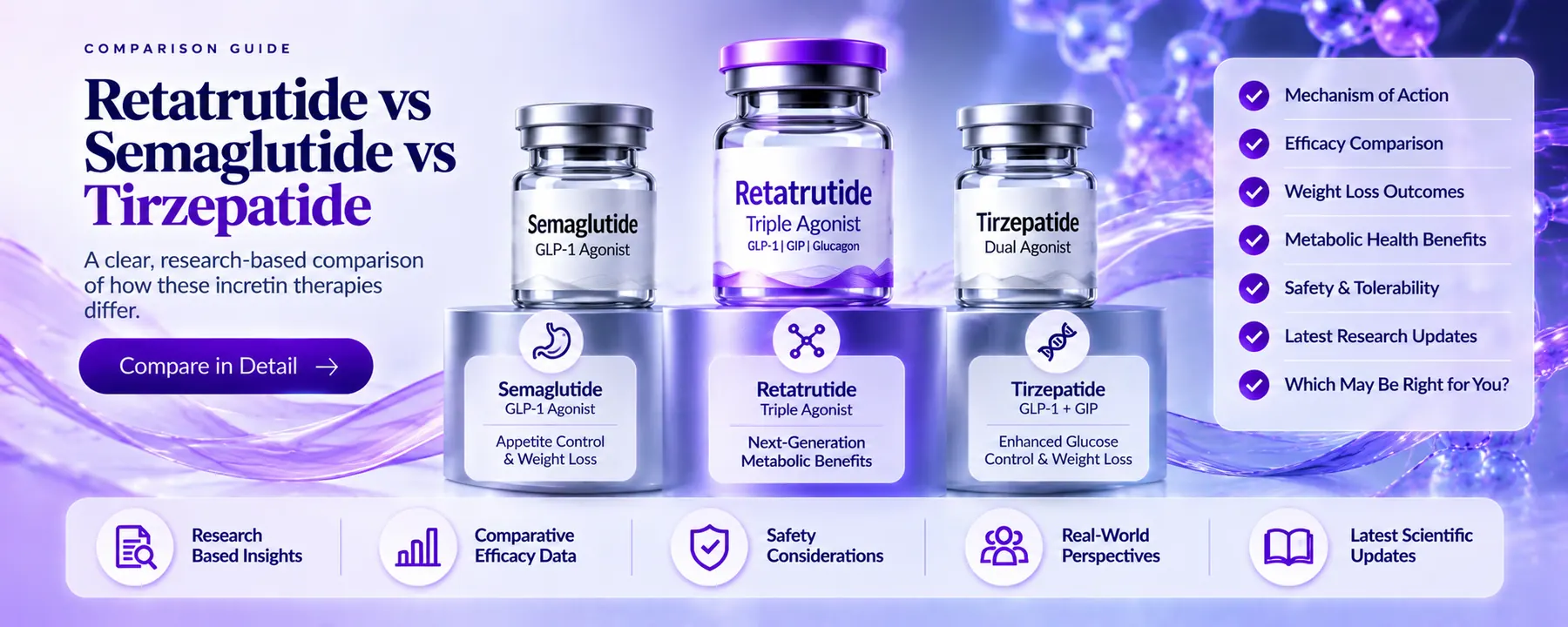
Retatrutide vs Semaglutide
The widest mechanistic gap in this class — one receptor against three — and the narrowest evidence base for comparing them.
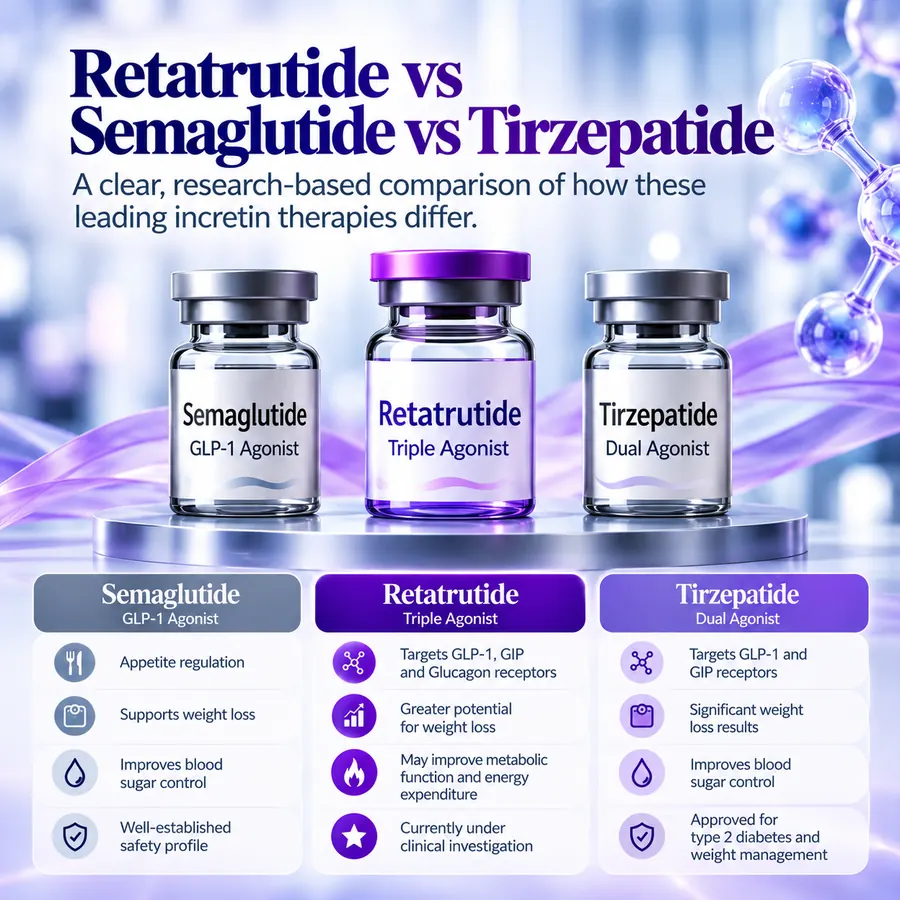
Semaglutide is a GLP-1 receptor agonist: one receptor. Retatrutide acts on three — GIP, GLP-1 and glucagon. Semaglutide is approved and marketed in many countries, under brand names including Ozempic and Wegovy. Retatrutide is investigational and approved nowhere.
No published head-to-head trial in obesity compares them. One registered head-to-head study exists (NCT06260722), but it is in adults with type 2 diabetes, it is open-label, and its primary endpoint is A1C, not weight. It had not reported as of 24 October 2026.
The mechanistic difference
| Semaglutide | Retatrutide | |
|---|---|---|
| GLP-1 receptor | Yes | Yes |
| GIP receptor | — | Yes |
| Glucagon receptor | — | Yes |
| Class | Mono-agonist | Triple agonist |
| Regulatory status | Approved in many countries | Investigational |
This is the widest mechanistic gap among the molecules commonly compared. Semaglutide engages the single best-characterised incretin pathway; retatrutide engages that one plus two others. Semaglutide also has by far the longest clinical track record of the three, which is its own form of evidence — years of post-approval use and pharmacovigilance that no investigational molecule can have.
What head-to-head evidence exists
| Field | Detail |
|---|---|
| Registry ID | NCT06260722 |
| Population | Adults with type 2 diabetes on metformin — not an obesity trial |
| Design | Phase 3, randomised, multicentre, open-label |
| Primary endpoint | Change in A1C at week 80 — not body weight |
| Enrolment | 1,250 |
| Status | Active, not recruiting |
| Results | Not reported as of 24 October 2026 |
Three reasons this trial will not settle the popular question
- Wrong population. It enrols people with type 2 diabetes. Weight responses in this class tend to differ between people with and without diabetes.
- Wrong endpoint. Its primary measure is glycaemic control, not weight.
- Open-label. Participants and investigators know which treatment is given, which can influence subjective reporting and behaviour in ways blinding prevents.
It will be a genuine head-to-head result, and a useful one. It will not be an answer to “which causes more weight loss in obesity”.
Why we will not compare the headline percentages
Retatrutide's reported figures come from the TRIUMPH programme. Semaglutide's come from its own trials, run in different years, in different populations, over different durations, analysed under different estimands. Subtracting one from the other produces a number with no defensible meaning.
The estimand problem alone is enough to break it. TRIUMPH-1's 12 mg result is 28.3% under one estimand and 25.0% under another — a 3.3 percentage-point swing from an analytical choice, within a single trial. Comparing across trials without matching that choice compares two different kinds of number. How estimands work →
What is settled today
Semaglutide is an approved medicine that can be lawfully prescribed and dispensed in many countries, with approved labelling, regulated manufacturing and active post-marketing surveillance. Retatrutide has none of those. Its developer states it “cannot be legally sold or marketed for human use”.