
Retatrutide Mechanism of Action
One molecule, three receptors. What each pathway is associated with, and the line between a mechanism and an outcome.
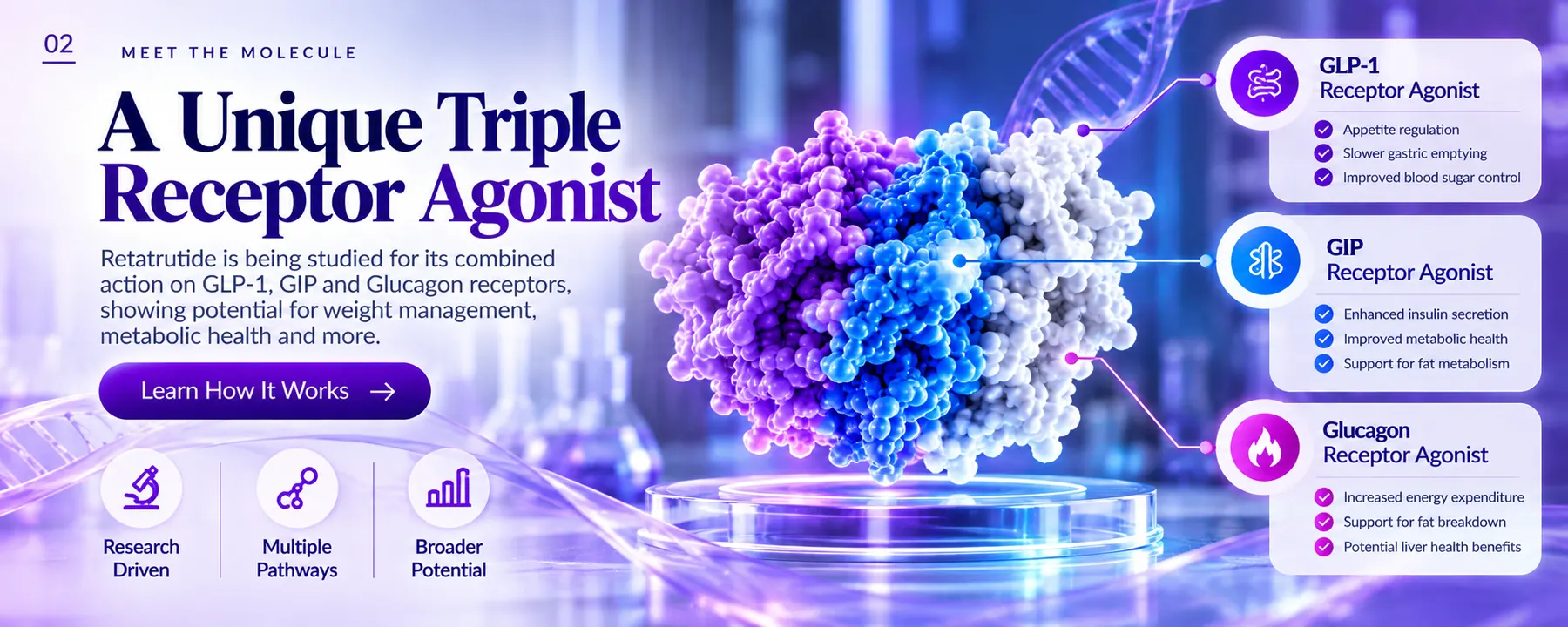
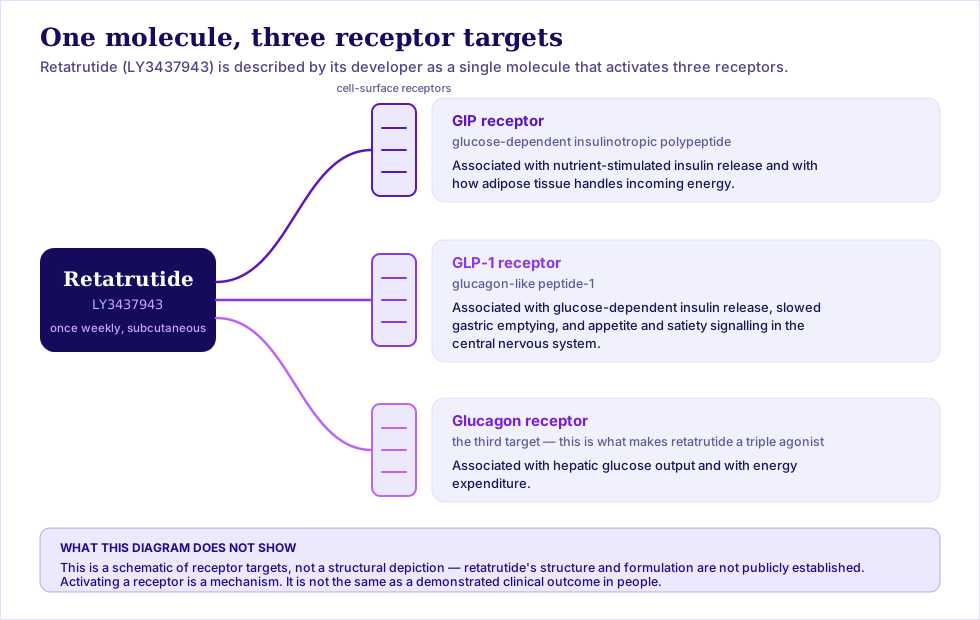
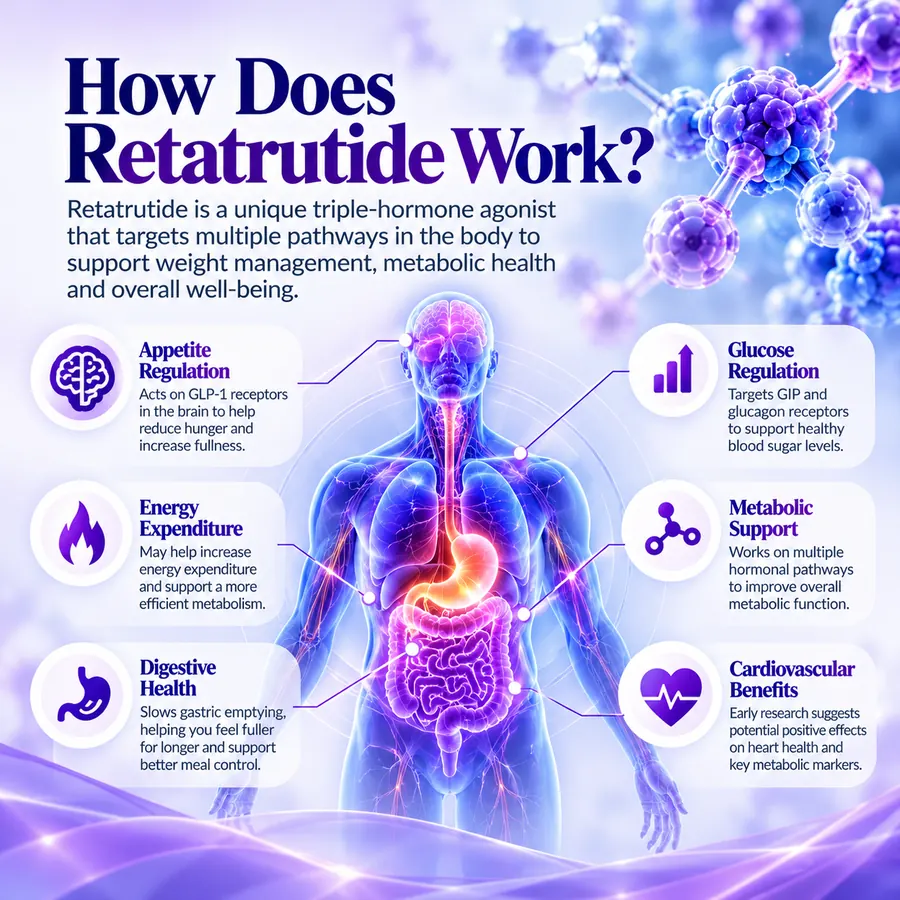
Retatrutide is a single molecule that activates three hormone receptors: the GIP receptor, the GLP-1 receptor and the glucagon receptor. Semaglutide acts on one of these; tirzepatide on two. The glucagon receptor is the third target, and it is what makes retatrutide a triple agonist. Its developer's stated rationale is that engaging all three may produce effects that engaging one or two does not — a hypothesis the clinical programme is testing, not a settled conclusion.
First, what “agonist” means
A receptor is a protein that responds to a specific signalling molecule. An agonist is something that binds a receptor and switches it on, producing a response similar to the body's own signal. An antagonist binds and blocks it instead.
So a “triple hormone receptor agonist” is a molecule that switches on three different hormone receptors. The word carries no claim about how well it works — it describes what the molecule does at a cellular level, not what happens to a person.
The three pathways
GLP-1 receptor — the familiar one
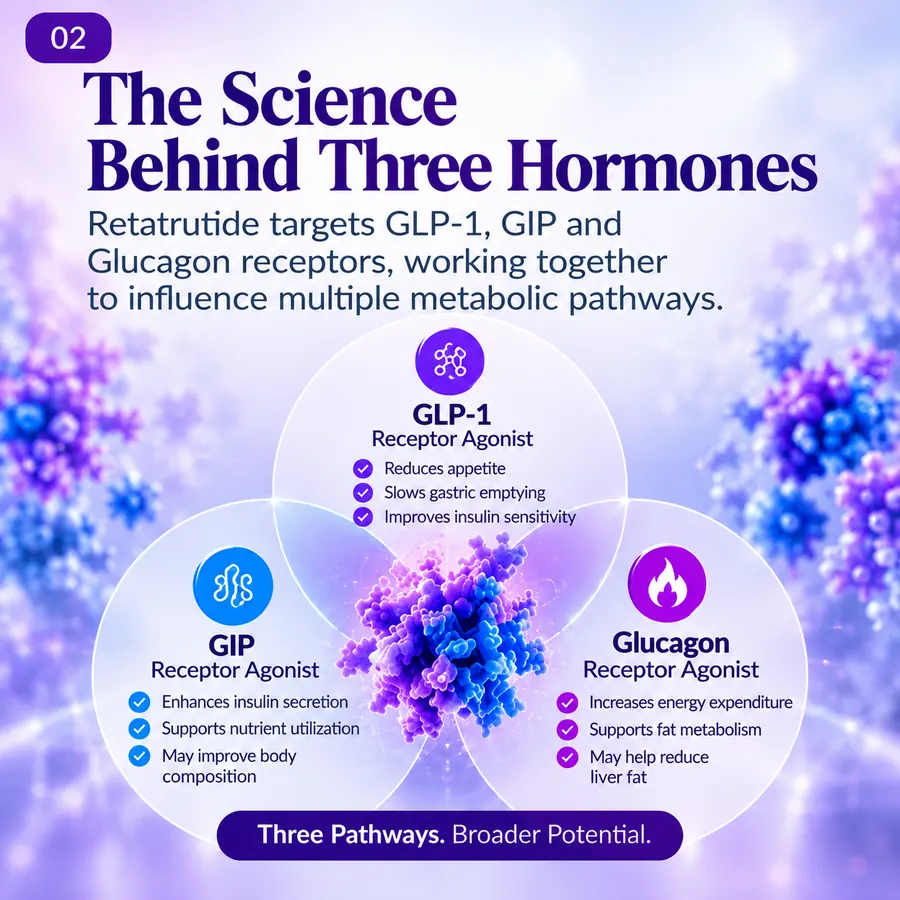
Glucagon-like peptide-1 is an incretin hormone released from the gut after eating. GLP-1 receptor agonism is the best-characterised of the three pathways, because medicines acting on it have been in clinical use for years. Published physiology associates this pathway with:
- Glucose-dependent insulin release — stimulating insulin when blood glucose is elevated, which is why the effect tends not to drive glucose below normal on its own.
- Slowed gastric emptying — food leaves the stomach more slowly.
- Appetite and satiety signalling — acting on central nervous system pathways involved in hunger and fullness.
GIP receptor — the second arm
Glucose-dependent insulinotropic polypeptide is the other major incretin hormone. This pathway is associated with nutrient-stimulated insulin release and with how adipose (fat) tissue handles incoming energy. GIP receptor agonism is a more recent therapeutic target than GLP-1, and the research literature on it is correspondingly younger.
Glucagon receptor — the differentiator
Glucagon is often introduced as insulin's opposite: it raises blood glucose by prompting the liver to release stored glucose. Adding a glucagon receptor agonist to a weight-management molecule can therefore look counter-intuitive.
The pathway is associated with two things that matter here: hepatic glucose output and energy expenditure. The second is the reason for interest. Where GLP-1 and GIP agonism are associated largely with reduced energy intake, glucagon receptor agonism is associated with energy expenditure — a different lever.
The developer's stated rationale
We believe that combining glucagon receptor agonism with GIP and GLP-1 receptor agonism may be one of the reasons retatrutide showed this level of weight reduction. Daniel Skovronsky, Chief Scientific Officer, Eli Lilly — 26 June 2023
Read the hedging carefully: we believe, may be, one of the reasons. This is a hypothesis from the molecule's developer about its own molecule. We report it because it is the stated scientific rationale, and we label it as a hypothesis because that is what it is.
Why the glycaemic results are worth noting
If glucagon raises blood glucose, does a glucagon receptor agonist worsen glycaemic control? The trial data speak to this question, and the answer is not what the simple version predicts.
In TRIUMPH-2, in adults with type 2 diabetes, A1C fell by 1.4% to 1.6% across the three doses against 0.2% on placebo. In TRIUMPH-3, hyperglycaemia was reported as an adverse event in 3.9% and 3.1% of the retatrutide groups against 13.4% on placebo — that is, less often on the molecule than off it.
What that does not prove
These observations are consistent with the combined effect of three pathways not being the sum of each pathway considered alone. They do not isolate the glucagon arm's contribution. No published human study separates how much each receptor arm contributes to the outcomes seen. Anyone attributing a specific share of retatrutide's effect to glucagon agonism is going beyond the published evidence.
Mechanism is not outcome
This distinction is the most important idea on the page, and the one most often lost.
| A mechanistic statement | An outcome statement |
|---|---|
| “Retatrutide activates the glucagon receptor.” | “Participants on 12 mg lost a mean 28.3% of body weight at 80 weeks.” |
| Describes what the molecule does at a receptor. | Describes what was measured in a defined population over a defined period. |
| Established by the molecule's design and characterisation. | Established by a randomised controlled trial, under a stated estimand. |
| Says nothing about how much weight anyone will lose. | Says nothing about any individual outside that trial population. |
A plausible mechanism is a reason to run a trial. It is not a substitute for one. The history of drug development is full of molecules with elegant mechanisms that failed to produce the expected outcome, and of approved medicines whose mechanism was only understood afterwards.
How this compares to other incretin medicines
| Molecule | GLP-1 | GIP | Glucagon | Class |
|---|---|---|---|---|
| Semaglutide | Yes | — | — | Mono-agonist |
| Tirzepatide | Yes | Yes | — | Dual agonist |
| Retatrutide | Yes | Yes | Yes | Triple agonist |
More receptors is not automatically better. Additional pathways can bring additional effects that are unwanted as well as wanted, which is one reason retatrutide's adverse-event profile is examined closely. See the full comparison with tirzepatide →